← All projects01/07 · Project overview
Company project · Acoustic system design
Balancing loudspeakers and sub-bass in a real venue.
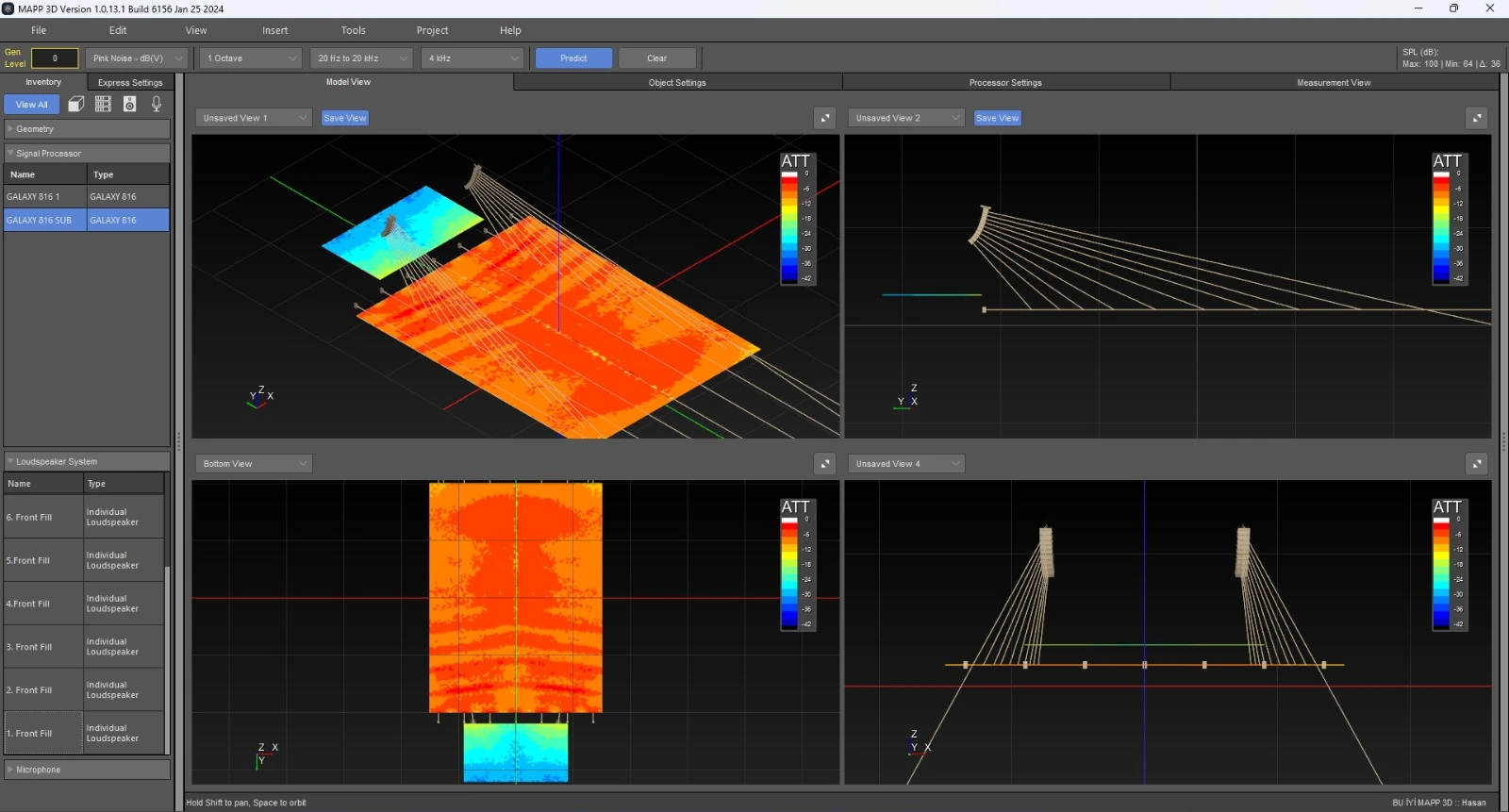
An acoustic system study in which I modelled loudspeaker and sub-bass placement for a real concert venue, balancing amplitude, coverage consistency and safe sound pressure levels.
- Role
- System modelling
- Tool
- MAPP 3D
- Focus
- Coverage · SPL · placement
- Context
- Concert venue
In short
Good sound is not simply loud sound. It is a controllable, safe system that remains as balanced as possible across every part of the venue.
Core question
Not how powerful the system is, but how it behaves in the space.
It was not enough to decide how many loudspeakers the venue needed. The real question was how the physical loudspeaker and sub-bass systems would affect different audience zones.
I looked for balanced coverage that would limit fall-off in distant areas without creating uncomfortable peaks in the front rows.
Approach
Testing the placement digitally first.
I modelled the venue geometry, loudspeaker arrays and sub-bass positions in MAPP 3D. By comparing the dispersion of different layouts, I could see where sound accumulated and where it fell away.
This turned an equipment list into a system decision: angle, direction, distance and coverage were evaluated together.
- More consistent coverage across audience zones
- Controlled peak sound pressure levels
- Low-frequency behaviour managed through placement
- A system configuration that could be implemented on site
Engineering decision
Every gain comes with a trade-off.
A change that strengthened one area could create a build-up elsewhere. Instead of pursuing one perfect graph, I looked for the most meaningful balance across the entire venue.
The model gave me a common language for decisions spanning technical performance, audience safety and installation realities.
What stayed with me
A technically powerful system is only truly effective when it becomes a clear and safe experience for everyone in the venue.
Let’s work together
Let’s solve a new problem together.
Up nextNext project · Aquamad →