← All projects03/07 · Unsuccessful / Put on hold
Product case · Fintech venture
Testing pay-at-table against business realities.
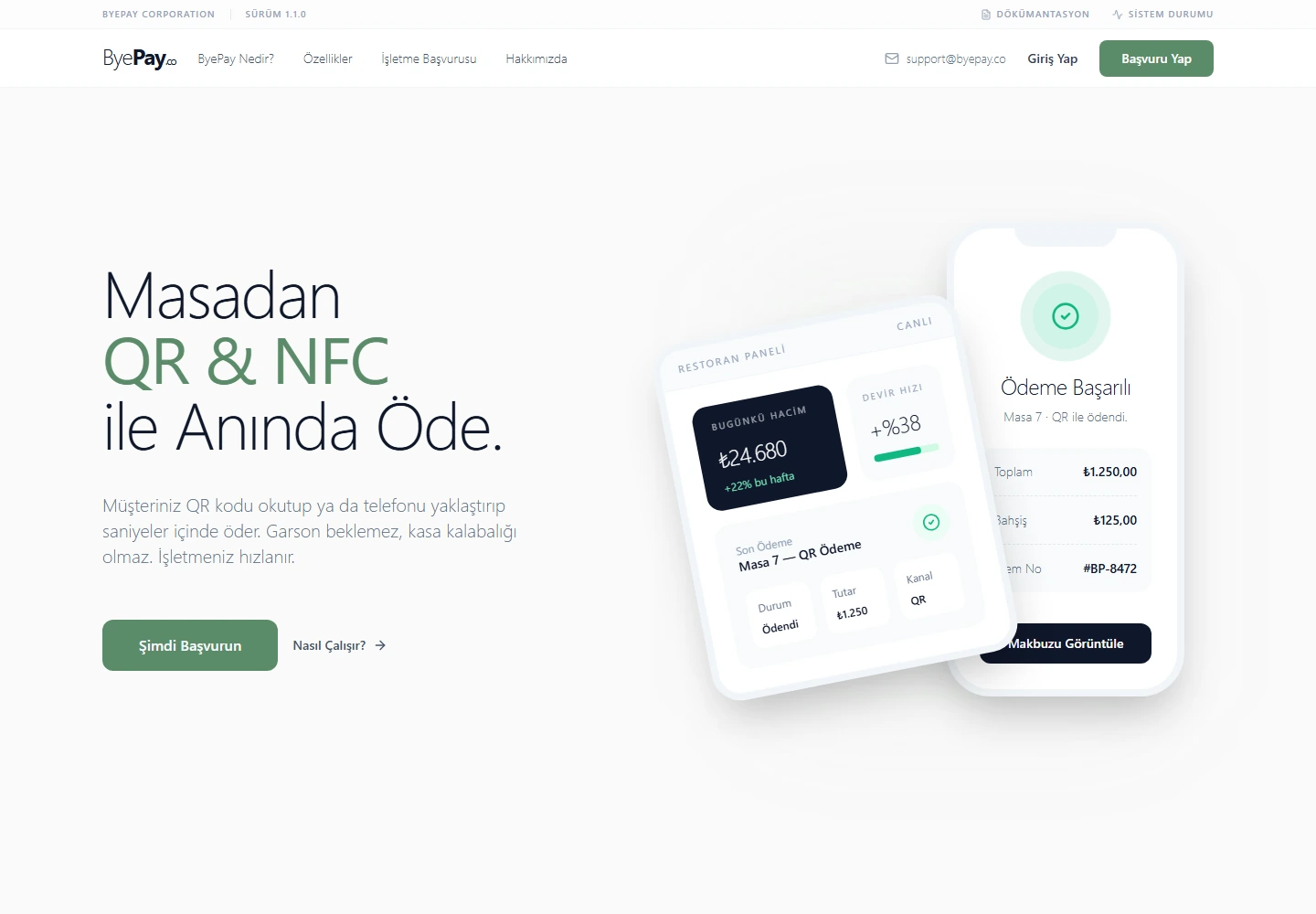
ByePay was a technology platform our four-person team developed to simplify pay-at-table experiences in restaurants and cafés through QR codes or NFC.
- Team
- 4 people
- Product
- QR & NFC pay-at-table
- Market
- Restaurants and cafés
- Outcome
- Put on hold · Learning case
In short
A good interface can accelerate payment, but in fintech the real system includes the regulation, reconciliation and integrations behind the screen.
Problem
The meal ends; the wait to pay begins.
At the final step of a restaurant visit, waiting for a server, asking for the bill, splitting it and then facing a queue at the till creates unnecessary friction.
ByePay's core promise was to let guests scan the QR code at their table or tap an NFC point, access the bill, choose their share, add a tip and complete payment.
Product system
Not a single payment screen, but a two-sided operation.
The merchant's POS integration, table matching, automated reconciliation and payment tracking mattered just as much as speed on the customer side.
We therefore designed the flow not simply as a customer interface, but as a system connecting the restaurant, payment infrastructure and operations dashboard.
- A web experience linked to the table through QR and NFC
- Bill splitting and tipping scenarios
- Merchant dashboard and payment tracking
- POS integration and reconciliation requirements
Market validation
Serious conversations raised even bigger system questions.
We took the product into partnership evaluations with large companies and held enterprise-level discussions. The process confirmed that the need was real, but also showed that technology alone could not complete the solution.
Tax structures, payment regulation and compatibility with public systems moved to the centre of the commercial model.
Why did it fail?
A working product was not, by itself, a sustainable business.
We reached negotiation and agreement stages with large businesses, but payment regulation, the tax system and required integrations made the commercial model unviable. We therefore put the product on hold.
The problem was not one missing feature. Even when the technology worked, it could not become a scalable system unless regulation and the business model were validated at the same time.
What did we learn?
Test the invisible side of the product earlier.
In fintech, payment licences, tax structures, stakeholder mapping, integration costs and the revenue model are as much a part of the product as the interface and technology. If we started again, we would validate them in parallel from the idea stage.
Making the failed assumptions visible instead of hiding the failure made our later product decisions stronger.
What stayed with me
The project did not reach the market, but it expanded my understanding of product development to include the market, regulation and business model.
Let’s work together
Let’s solve a new problem together.
Up nextNext product · D&D Game →